

Buying Your First Home in Malaysia? Check These 5 Things First

Published:
Last updated:
When people visit a showroom for the first time, they usually ask:
Is it beautiful? Is the pool nice? How is the view?
Those things are fine to look at.
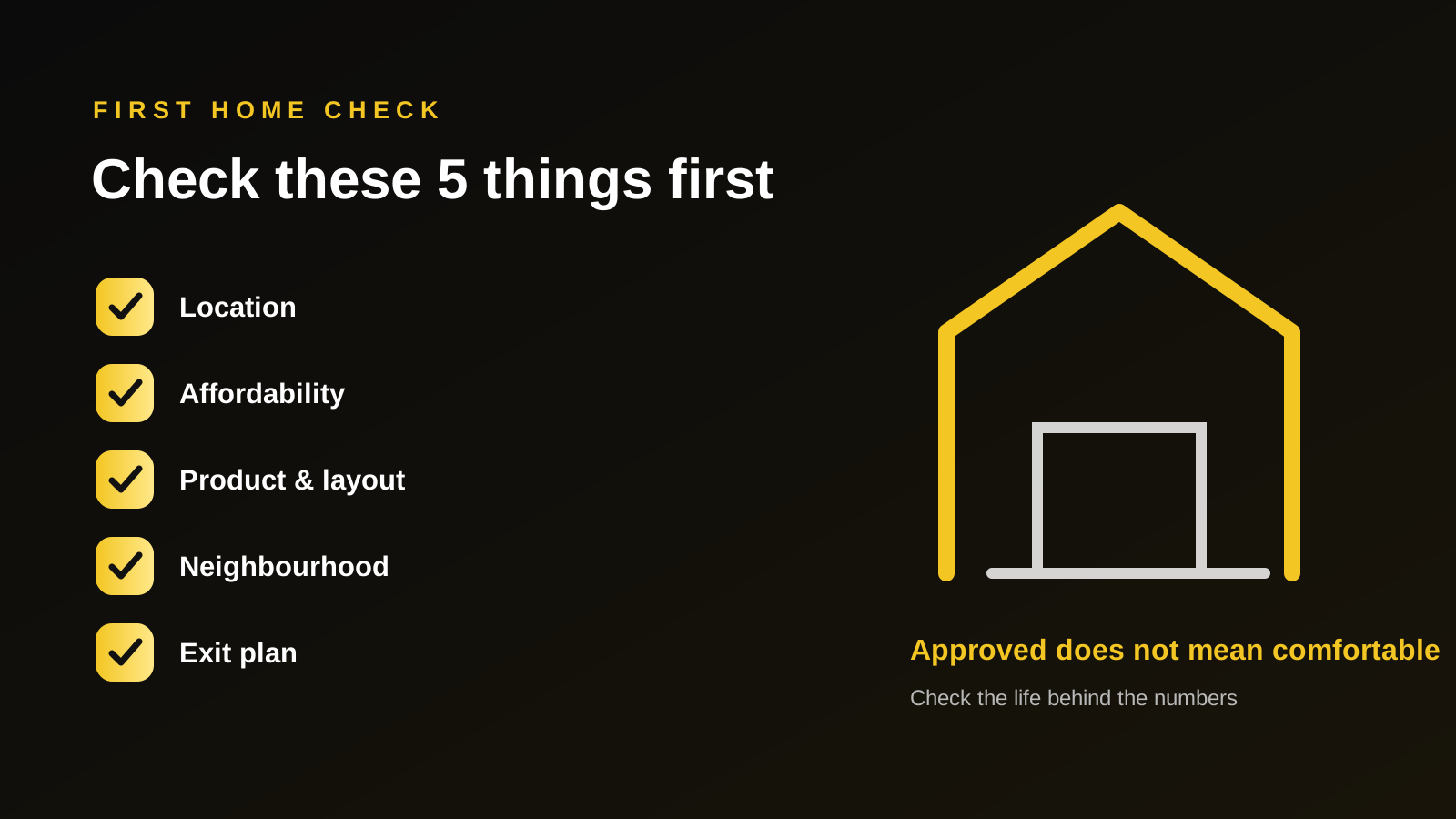
But if I am helping a first-home buyer, I will not begin by asking whether they like it. I will check five other things first.
Liking a home does not automatically mean living with the decision will be comfortable.
1. What actually makes a location good?
A good location is not just one that looks near on Google Maps.
Where do you work? What time do you leave home? How long is the real peak-hour drive? Can you genuinely walk to the MRT, or does the advertised 800 metres involve a major road and no shade?
Then look at the daily neighbourhood: food, groceries, clinics, schools where relevant, and whether it is convenient when your parents visit.
I do not judge a location from Google Maps alone. If possible:
- Visit during the day and observe traffic and surrounding activity.
- Return at night and notice lighting, people and how it feels coming home.
- Drive your actual route during a weekday peak hour.
You may see a completely different place each time.
2. If the bank will lend, does that mean you can afford it?
No. Loan approval means the bank assessed repayment using its criteria. Whether your life remains comfortable afterwards is a separate question.
Being able to buy and being able to service it comfortably are two different things.
Do not look at the monthly instalment alone. Include:
- Maintenance fees and sinking fund
- Parking, insurance, utilities and internet
- Legal and financing documents, renovation and furniture
- The small repairs that appear after moving in
- Whether you still have room if financing costs change
There is no universal DSR number that suits everyone. Income structure, family commitments and bank calculations differ. My practical baseline is simpler: after buying, you should still have an emergency fund and enough room to live normally.
3. Does a well-known developer mean you can ignore the product?
No. Track record, delivery and defect handling matter, but density, design, management and location can differ between projects from the same developer.
- How many units and lifts are there on each floor?
- Is parking practical, and how are visitors handled?
- Can the bedroom still function after placing a bed and wardrobe?
- Are the kitchen, laundry and storage spaces actually usable?
- Who maintains the common areas, and are the fees reasonable?
Showroom lighting, mirrors and furniture proportions can make a space feel better. Go back to the floor plan and measure instead of relying only on first impressions.
4. You are buying more than the unit
Every day you will pass the road junction, guard house, parking area, lobby, lift and corridor before reaching your front door. Shops, traffic, noise and community management all affect your experience.
You are not only buying 900 sqft. You are also buying the environment downstairs, next door and outside your home.
Ask who normally lives there, whether short-term rental is common, how the entrance behaves during peak hour and how the area feels at night.
5. Think about your exit options before you buy
An exit plan does not mean planning to sell immediately. It means accepting that life changes.
- Who would rent here, and why would they choose it?
- Who could be the next buyer, and what would matter to them?
- How much similar supply exists nearby?
- Can you hold the property if it takes months to rent or sell?
NAPIC's H1 2026 report recorded 33,094 completed but unsold residential units nationwide, with major differences by state, price and product type. The number is not a reason to avoid buying. It is a reminder to verify real demand instead of assuming somebody will always take over later.
My five-minute final check
- Can I comfortably afford the instalment and full holding cost?
- Would I accept this commute for the next five years?
- Is the layout still practical without showroom furniture?
- Is there real demand from residents, tenants or future buyers?
- If life changes, do I have room to change direction?
Your first home does not have to be perfect.
But try not to buy one that becomes difficult to leave when your life changes.
Official sources
Official data provides market context. The location, affordability and exit-plan discussion reflects Axly's practical view, not a guarantee of returns or personalised financing advice.