

I Am Comfortable Renting. Why Should I Consider Buying?

Published:
Last updated:
“Axly, I am renting for RM2,000 and living comfortably.
A mortgage may cost more, and I still have maintenance, renovation and legal fees.
Why should I buy?”
That is a good question.
If you do not understand why you are buying, do not buy just because somebody tells you to.
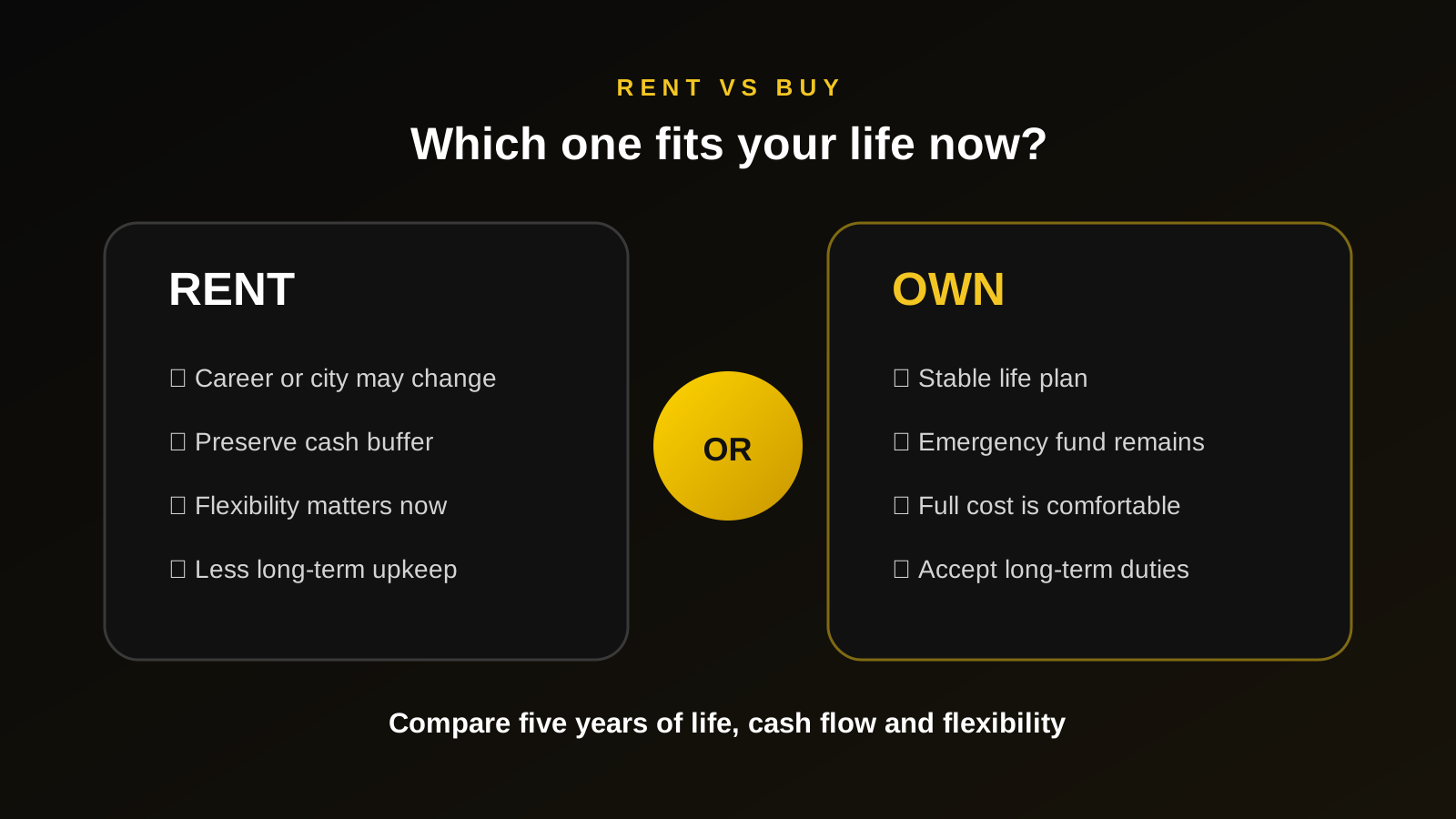
When does renting make more sense?
- Your work location is uncertain and you may move within one or two years.
- Your income fluctuates and you have not built an emergency fund.
- Buying in the area you genuinely want costs far more than renting there.
- You value mobility and do not want a property to restrict your next move.
- The down payment would use almost all your available cash.
In these situations, I would rather you rent first. Renting buys flexibility when your work, family or city changes. I am not anti-renting; it can be a very rational decision.
Is rent “wasted money”?
No. Rent pays for the right to live somewhere, location choice and generally fewer maintenance responsibilities. Those are real benefits.
Rent also is not fixed forever. Renewal costs may rise or stay flat depending on location, supply and market conditions. A long-term renter accepts that future rent and renewal terms are not fully under their control.
The useful question is not whether rent is wasted. It is whether the flexibility you receive is worth the total housing cost for your current stage of life.
Why is buying still worth considering?
1. More housing stability
As long as you continue meeting the financing and management responsibilities, a landlord cannot suddenly decide not to renew. You usually have more control over renovation, pets and how you use the space.
The trade-off is lower flexibility. Moving city is not as simple as ending a tenancy.
2. Not every ringgit of your instalment becomes an asset
A housing loan instalment normally contains financing cost and principal. Principal gradually reduces what you owe and increases your ownership stake.
Do not describe the entire instalment as savings. Financing costs, insurance, maintenance, repairs, transaction costs and opportunity cost are real expenses.
3. It can create long-term discipline
For some people, a regular housing commitment makes them prioritise long-term asset building. But property is illiquid, cannot be withdrawn like a savings account and is not guaranteed to rise in value.
Does 1.8% inflation mean prices became cheaper?
No.
DOSM reported Malaysia's headline CPI rising 1.8% year-on-year in September 2026. That means the overall price level was still increasing, just at a slower rate than before.
Inflation of 1.8% does not mean prices fell 1.8%. It means prices were still rising overall, only more slowly.
That also does not mean property prices must rise. NAPIC's Q2 2026P data showed the national house price index about 0.9% higher year-on-year but 0.5% lower quarter-on-quarter, with different results across major states.
Malaysia is not one single property market. Do not apply a national average directly to the specific building you are considering.
When would I tell you not to buy yet?
- The down payment would wipe out all your savings.
- Your job is unstable or you may leave the city within two years.
- Credit-card or personal-loan debt already makes every month tight.
- You are buying only because friends bought or a salesperson says it is the last unit.
- You do not understand who lives, rents or buys in the location.
- The entire plan depends on a guaranteed salary increase next year.
Buying should make your future more stable, not make every month feel impossible from the first day.
Axly's simple five-question check
- Will I probably remain in this city for the next five years?
- Is my income relatively stable?
- Will I still have emergency cash after buying?
- Can I comfortably afford the full monthly housing cost?
- Is there real rental or resale demand if my plans change?
If most answers are no, renting first is fine. If most are yes, it is worth comparing suitable homes seriously.
Renting is not losing. Buying does not automatically win.
The real question is whether the person you become five years from now will thank you for today's decision.
Official sources
- DOSM: Consumer Price Index, September 2026
- NAPIC: Malaysian House Price Index Q1–Q2 2026P
- Bank Negara Malaysia: Responsible lending and repayment capacity
This is general buyer education, not personalised financing, tax or investment advice. CPI and MHPI data provide market context and do not predict the outcome of any individual property.