

For Your First Home, Is Location or More Space More Important?

Published:
Last updated:
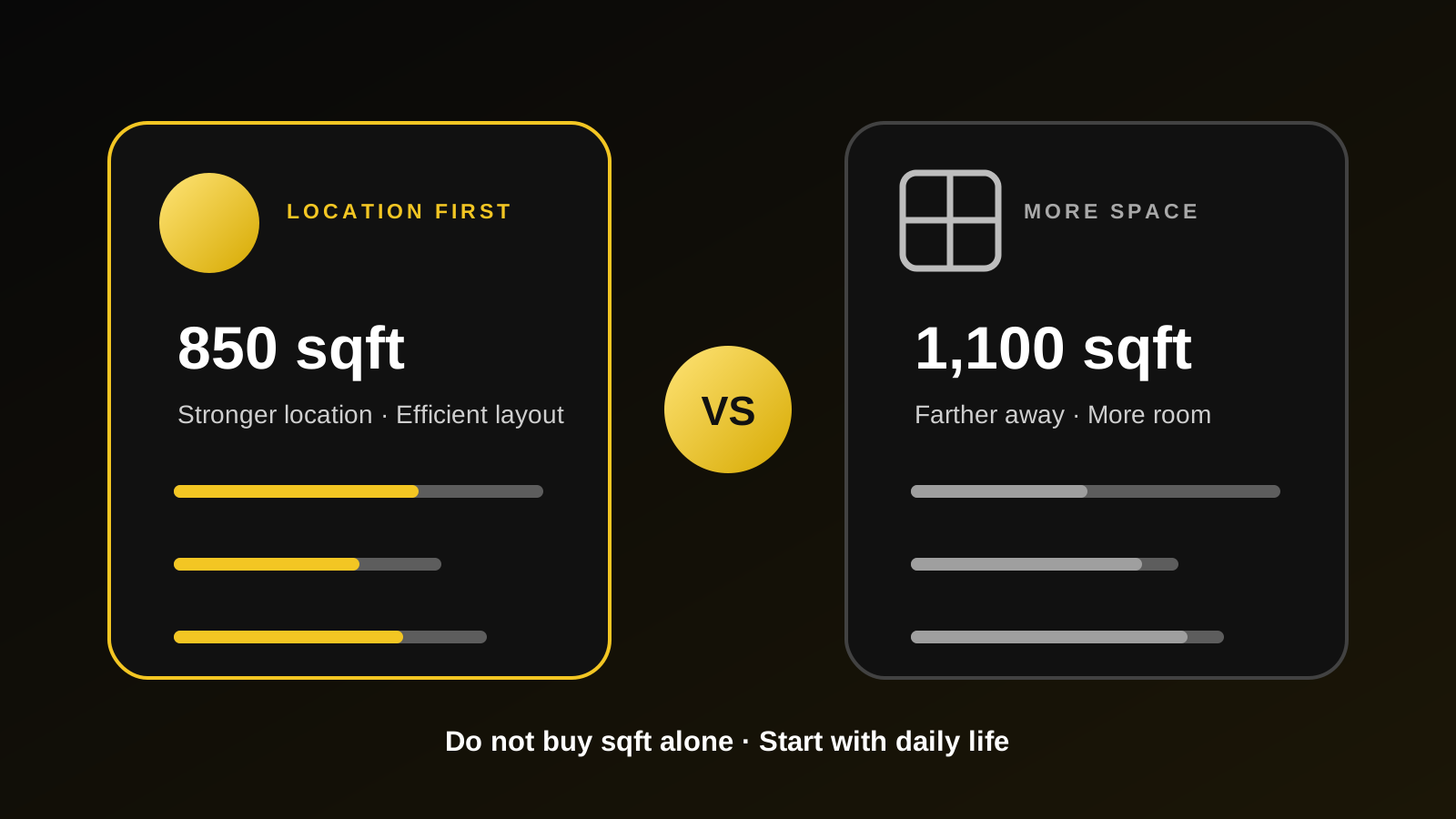
Same RM500k budget.
A: 850 sqft in a stronger location.
B: 1,100 sqft, but farther away.
Many people immediately choose the larger home because it feels like better value.
I do not always see it that way. For a first home, I usually look at how you live every day before I look at the sqft.
Why do I usually look at location first?
1. You are buying daily time, not only distance
An extra 15km does not automatically mean 15 more minutes. If the commute adds 45 minutes each way, that is 90 minutes every office day.
Do not use that example to frighten yourself. Drive the real route during peak hour. Consider how often you go to the office, when you return home and whether you need to pick up children or care for family.
2. Location affects the future pool of people who may want the home
Convenient locations with established amenities and nearby employment usually appeal to a wider group of owner-occupiers, tenants and future buyers.
I said usually, not guaranteed appreciation. Overpaying, weak management and too much competing supply can still hurt rental and resale outcomes.
3. A good location is convenience you genuinely use
MRT access matters to someone who rides it daily. Schools matter to families. Healthcare access may matter more when caring for parents.
There is no universal location ranking. Start with how you expect to live over the next five years.
When should the larger home win?
- You already have children or expect your household to grow soon.
- Your parents will live with you and need a genuinely usable room.
- You work from home long-term and need a quiet workspace.
- You have two cars, equipment or specific storage needs.
- You are buying for long-term own stay and accept the longer commute.
If you will use the extra 200–300 sqft every day, it has real value. If the only reason is that the number looks larger, two extra hours of commuting may not be a good trade.
Is 850 sqft too small? Check the layout first
Square feet can be misleading.
An efficient 850 sqft home with rectangular rooms, little wasted corridor space, a practical kitchen and a well-proportioned living room can feel better than a poorly planned 1,000 sqft unit.
The larger unit may lose useful space to long corridors, awkward corners, an oversized balcony you rarely use or rooms that do not fit normal furniture.
Do not buy sqft alone. What matters is how much space you can genuinely use every day.
Malaysia is not one single property market
NAPIC's Q2 2026P house price index showed different results across major states: Johor was about 3.6% higher year-on-year, Kuala Lumpur 2.7%, Pulau Pinang 0.2% and Selangor 1.1% lower.
This does not mean you should chase the strongest state, and it does not mean every area within a state behaves the same way. The useful lesson is to research the specific neighbourhood, product and price instead of asking only what “Malaysia property” will do.
My practical order for a first home
- Affordability: make sure the full cost is comfortable.
- Location: check whether daily life and commuting make sense.
- Layout efficiency: see how much space is genuinely usable.
- Actual space needed: decide how many rooms your household and work require.
- Developer and building quality: consider delivery, maintenance and density.
- Future flexibility: keep options for own stay, rental or resale.
This is not a universal rule. It is simply the order I find practical when helping a first-home buyer compare choices.
Your first home does not have to solve every future need.
A well-located home that you can comfortably afford and change direction from may matter more than stretching yourself for another 200 sqft.
Official sources
State-level indices are market context, not a substitute for assessing a specific location, project, unit and purchase price. The priority order above is Axly's practical preference, not a guarantee of appreciation.